Sodium Palladium Chloride
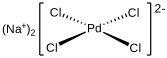
Physical Properties
- Molecular Weight: 294.21 g/mol
- Solubility (20°C): 1000 g/L
Also known as: Palladium Chloride, Sodium Tetrachloropalladate(II), Na2PdCl4, Sodium Chloropalladite, Sodium Palladium(II) Chloride
Sodium palladium chloride (sodium tetrachloropalladate(II), Na₂PdCl₄; CAS 13820-53-6) is the palladium salt of platinum-palladium printing, and the metal source in every all-palladium print. It is made from palladium chloride (PdCl₂; CAS 7647-10-1) and common salt, and the two names are used interchangeably on the bench even though only the sodium salt dissolves cleanly in water. Palladium sits directly above platinum in the periodic table and behaves the same way under iron-oxalate photoreduction, at a fraction of the price and with a warmer image tone, brown-black rather than platinum's cool neutral.[1] Most contemporary printers work in pure palladium and add platinum only for tone.
Sodium palladium(IV) chloride
The name searchers arrive with is not quite the printing salt. Sodium palladium(IV) chloride, or sodium hexachloropalladate, Na₂PdCl₆, is the palladium(IV) compound: six chlorides on a palladium in the +4 state, made by chlorinating the +2 salt. It is a dark red-brown solid, unstable in solution, and not used in photography. The printing salt is sodium palladium(II) chloride, sodium tetrachloropalladate, Na₂PdCl₄, with four chlorides on palladium(II). Suppliers sell the (II) salt as "sodium palladium chloride solution" or "sodium chloropalladite", and the older photographic literature calls it simply palladium chloride. If a catalogue entry says (IV), it is the wrong compound for the darkroom.
Properties at a glance
| Property | Value |
|---|---|
| Photographic salt | Sodium tetrachloropalladate(II), Na₂PdCl₄ |
| Other names | Sodium palladium chloride, sodium chloropalladite, disodium tetrachloropalladate |
| Molar mass | 294.21 g/mol anhydrous; the trihydrate, the usual commercial form, is 348.3 g/mol |
| CAS number | 13820-53-6 |
| Parent compound | Palladium(II) chloride, PdCl₂, 177.33 g/mol, CAS 7647-10-1; itself only sparingly soluble in water |
| Appearance | Red-brown to dark brown crystals; deep amber-brown solution |
| Solubility | Freely soluble in water; PdCl₂ needs added chloride or a little acid to dissolve |
| Palladium content | 36 % by weight in Na₂PdCl₄; 60 % in PdCl₂ |
| Hazard codes | Na₂PdCl₄: H290, H302, H317, H318. PdCl₂ (the alternative starting material): H302, H314, H317 |
Photographic mechanism
The iron salt does the light-sensitive work. Ultraviolet reduces ferric oxalate to the ferrous state where the negative lets light through; in the developer, that ferrous iron gives its electron to palladium(II), which drops out as fine particles of metallic palladium in the paper fibres. The same reaction runs faster than the platinum equivalent, which is why palladium prints show more image during exposure and why they are the more forgiving of the two metals to learn on.[2] The reduced metal is so finely divided that its colour comes from particle size as much as from the element, which is where humidity, developer temperature and paper move the tone between warm brown and near-neutral.
Common photographic uses
- Palladium printing: sensitizer of ferric ammonium oxalate or ferric oxalate plus the palladium solution, coated on cotton rag paper, exposed under UV through a contact-size negative, and developed in potassium oxalate or ammonium citrate. Warm-toned, with the same tonal range and permanence as platinum. The full procedure is on photography-fyi under platinum-palladium printing and the formula under the platinum-palladium recipe.
- Mixed platinum-palladium sensitizer: the palladium solution and potassium chloroplatinite mixed drop for drop in any ratio; two parts palladium to one part platinum is a common house standard that balances warmth, contrast and cost.
- Palladium toning of silver prints: a dilute solution shifts a silver print toward warm brown with some gain in permanence; rarely used now that selenium and gold toners are cheaper per print.
- Historical substitute for platinum: when the First World War made platinum unobtainable, Willis's company sold Palladiotype paper from 1916, and palladium carried the process until both papers disappeared in the 1930s. Modern printers choose it for price and tone rather than necessity.
Making the palladium stock solution
The standard "Solution 3" for palladium is 15 to 20 per cent sodium tetrachloropalladate in water, reckoned on the anhydrous salt. From the sodium salt: weigh 15 g of the anhydrous salt, or 17.8 g of the trihydrate (which is what most suppliers ship; check the label, since 15 g of trihydrate gives only a 12.7 per cent stock), dissolve in distilled water and make up to 100 ml. From palladium chloride: dissolve 9 g of PdCl₂ and 6 g of sodium chloride in about 60 ml of distilled water, warming and stirring until the solid has gone and the solution is a clear deep brown, then make up to 100 ml; this also yields a 15 per cent anhydrous-equivalent stock. The salt reacts with the chloride to form the soluble sodium salt in the bottle. A few drops of hydrochloric acid speed dissolving and keep the solution clear. Store in an amber dropper bottle; the solution keeps indefinitely in the dark and can be filtered if it throws a sediment.
Count the cost by the drop. At 15 per cent anhydrous-equivalent, one millilitre holds about 0.15 g of salt, or roughly 0.05 g of palladium metal, and gives about twenty drops. An 8 × 10 print takes twelve drops of palladium solution or so, which at 2026 prices is a few dollars of metal per sheet, against roughly double for the same print in platinum.
Practical notes
- Buy the sodium salt if you can. It dissolves at room temperature and weighs out predictably; palladium chloride is cheaper per gram of metal but needs the salt-and-heat step and tends to leave a residue.
- Weigh on a clean glass or plastic dish. Palladium solutions stain steel and are stained by iron; keep them away from the brush ferrule as well as the balance pan.
- Dropper bottles, not pipettes. Every drop of metal solution is money; a dedicated glass dropper bottle for each metal solution avoids cross-contamination and waste.
- The solution is the reagent of record. Write the batch date and concentration on the bottle; a stock made from PdCl₂ at a slightly different strength changes drop ratios in the mix.
- Recover the metal. Clearing baths, wash water and test strips carry palladium. Collect them, and the trimmings of spent prints, for a refiner; several suppliers buy palladium scrap back.
Related compounds
- Potassium chloroplatinite — the platinum(II) sibling: same chemistry, cooler tone, twice the price.
- Chloroplatinic acid — a platinum(IV) salt; the analogue of the palladium(IV) compound above and, as sodium hexachloroplatinate, the contrast agent of the Na2 method.
- Ferric ammonium oxalate and potassium oxalate — the sensitizer and developer the palladium salt is used with.
- Gold chloride — the other noble-metal salt in the darkroom, used for toning rather than printing.
References
- WEB alternativephotography.com alternativephotography.com. https://www.alternativephotography.com/ ↩
- BOOK Modern Photographic Processing, Volume 2 1st ed. John Wiley & Sons, 1979. ISBN 0-471-04635-X. ↩
- WEB Sigma-Aldrich Safety Data Sheets Sigma-Aldrich. https://www.sigmaaldrich.com/US/en/search/safety-data-sheets ↩