Pyrogallol
Physical Properties
- Molecular Weight: 126.11 g/mol
- Solubility (20°C): 400 g/L
Also known as: Pyrogallic Acid, Pyro, 1,2,3-Trihydroxybenzene
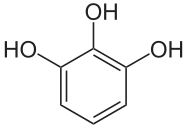
Pyrogallol (1,2,3-trihydroxybenzene, C₆H₃(OH)₃; CAS 87-66-1), commonly called pyro, is the classical staining / tanning developer of photography — the oldest developing agent still in serious use, first applied to photographic work in the 1850s.[1] Pyrogallol develops a normal silver image but simultaneously deposits a yellow-brown stain proportional to image density, produced by oxidation polymerization of the developer around each developed silver grain. The stain acts as a density-boosting mask on the negative, extending effective printing contrast — particularly valuable for contact printing on silver chloride papers and alt-process materials (platinum/palladium, cyanotype) that respond to UV transmission rather than visible density.
Photographic uses
- ABC Pyro / Wimberley's formula: The classical three-stock pyro developer. Solution A = pyrogallol + sodium sulfite; B = alkali activator; C = potassium bromide restrainer. Mixed in ratios just before use; working solution has ~4 minute life.[2]
- PMK (Pyro-Metol-Kodalk): Gordon Hutchings's 1991 reformulation — the most widely-used modern pyro developer. Balances staining with cleaner highlights than ABC pyro.
- Pyrogallol-HD: High-dilution stand-development variant using pyrogallol at 1:100 or greater dilution with minimal agitation.
- Tanning developer for specialty carbon processes: Hardens gelatin in proportion to image density, allowing etching-style selective dissolution for certain art printing techniques.
Practical notes
Supplied as white to pale tan crystalline powder. Darkens rapidly on air exposure — a freshly-opened container looks almost white; the surface yellows to brown within hours. Darkened crystals are still usable but weigh slightly more than their active content (the surface is partially oxidized to melanin-like polymer). Store in amber glass with desiccant for extended shelf life.
Solutions oxidize vigorously in open air — this is why pyro developers are mixed as separate stock solutions and combined immediately before use. Working-strength pyro in an open tray turns dark brown within a few minutes, and images must be developed promptly.
Related compounds
Pyrocatechol is the 1,2-dihydroxybenzene sibling used in the lower-toxicity Pyrocat-HD formula. Hydroquinone is the 1,4-dihydroxybenzene cousin — different chemistry, no staining.
References
- BOOK The Keepers of Light: A History and Working Guide to Early Photographic Processes 1st ed. Morgan & Morgan, 1979. ISBN 0-87100-158-6. ↩
- BOOK The Darkroom Cookbook 4th ed. Focal Press, 2016. ISBN 9781138959170. ↩
- WEB Sigma-Aldrich Safety Data Sheets Sigma-Aldrich. https://www.sigmaaldrich.com/US/en/search/safety-data-sheets ↩