Sodium Bicarbonate
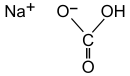
Physical Properties
- Molecular Weight: 84.01 g/mol
- Solubility (20°C): 96 g/L
Also known as: Baking Soda, Sodium Hydrogen Carbonate
Sodium bicarbonate (NaHCO₃; CAS 144-55-8), better known as baking soda, is the mildest alkali in the developer-chemistry toolbox. Solutions produce pH around 8.3 — too low to activate phenolic developing agents on its own but useful as a buffering component in specialty formulas, a pH-control additive for exhausted developer revival, and a neutralization agent for spilled acid.[1]
Photographic uses
- Buffer in colour-process formulas: Some C-41 and E-6 variants use sodium bicarbonate to hold working pH in the 7.5–8.5 range where specific developer-bleach balance matters.
- Fine-grain developer additive: Occasional formulas add a small amount of bicarbonate to existing MQ / PQ recipes for softer working.
- Acid neutralization: Dry bicarbonate sprinkled on spilled acid (acetic, sulfuric) neutralizes rapidly and safely — a good general-purpose darkroom spill cleanup aid.
- Developer exhaustion rescue: Adding a trace of bicarbonate to a nearly-exhausted MQ developer briefly restores pH and extends tray life for one more short session, at the cost of slightly altered contrast.
Practical notes
Supplied as fine white crystalline powder. Food-grade baking soda is indistinguishable from ACS-grade sodium bicarbonate for all photographic purposes and far cheaper.
Thermal decomposition: Bicarbonate releases CO₂ and water when heated above ~50 °C, converting to sodium carbonate (Na₂CO₃). This matters if a formula calls for specifically bicarbonate rather than carbonate — do not warm aggressively during mixing.
Related compounds
Sodium carbonate is the decomposition product and the more common darkroom alkali. Borax is the next-gentlest alkali up the activity ladder. Potassium bicarbonate substitutes 1:1 for sodium bicarbonate in all formulas.
References
- BOOK Modern Photographic Processing, Volume 2 1st ed. John Wiley & Sons, 1979. ISBN 0-471-04635-X. ↩