Sodium Selenite
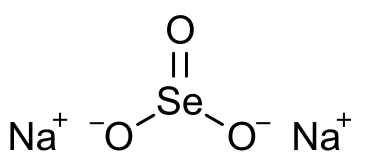
Physical Properties
Also known as: Selenium Toner (source), Na2SeO3
Sodium selenite (Na₂SeO₃; CAS 10102-18-8) is the direct-toning form of selenium — an alternative to selenium toner concentrate for workers who prefer mixing their own toner from defined ingredients.[1] Dissolved in ammonium thiosulfate at carefully-controlled concentrations, sodium selenite produces the same silver-to-silver-selenide conversion as commercial selenium toners but with more precise control over selenium concentration and pH.
Photographic uses
- DIY selenium toner formulation: 1–5 g/L sodium selenite in ammonium thiosulfate (or hypo clearing agent) produces a working selenium toner. Working strength varies with intended purpose: low concentration for archival only, higher for visible tone shift.
- Research-grade toning calibration: Densitometric workflows benefit from the known sodium-selenite concentration versus the proprietary commercial concentrates.
- Specialty archival treatments: Some conservation protocols for historical silver gelatin prints specify sodium selenite as the defined selenium source for reproducible results.
Practical notes
Supplied as white to pale yellow crystalline powder. Soluble in water (~85 g/100 mL at 20 °C). Solutions are mildly alkaline (pH ~8.5) and stable in closed containers for months.
Formulation precision matters: selenium toning is concentration-sensitive, and 10% over-concentration can produce a much more aggressive tone shift than intended. Weigh sodium selenite on a precision scale (0.01 g resolution) for reproducible results.
Related compounds
Selenium toner concentrate is the ready-to-use commercial formulation containing a related selenium species. Selenium dioxide is the raw selenium oxide. Sodium sulfide is the primary sulfur-based alternative toner.
References
- BOOK Modern Photographic Processing, Volume 2 1st ed. John Wiley & Sons, 1979. ISBN 0-471-04635-X. ↩
- WEB Sigma-Aldrich Safety Data Sheets Sigma-Aldrich. https://www.sigmaaldrich.com/US/en/search/safety-data-sheets ↩