Sodium Hydroxide
Physical Properties
- Molecular Weight: 40 g/mol
- Solubility (20°C): 1090 g/L
Also known as: Caustic Soda, Lye, NaOH
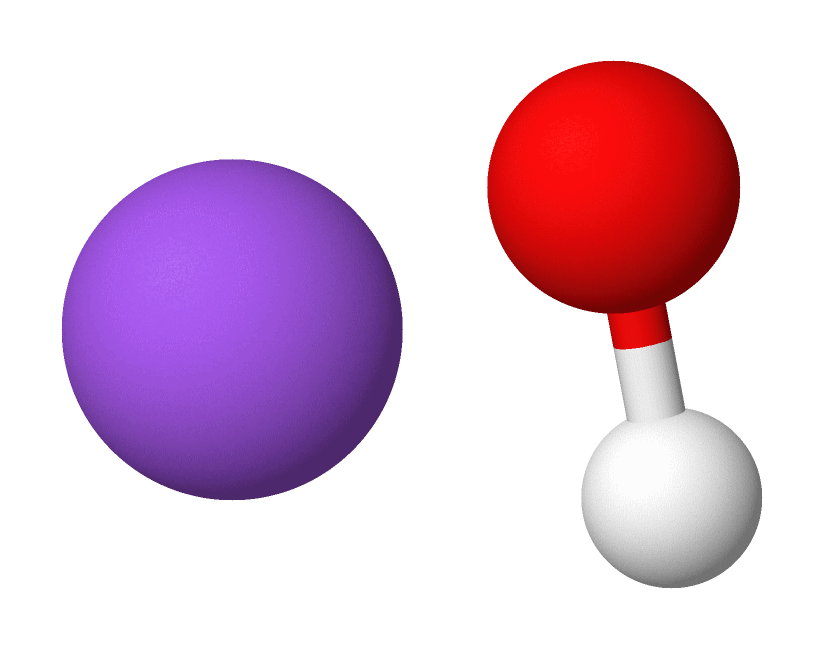
Sodium hydroxide (NaOH; CAS 1310-73-2), also called lye or caustic soda, is a very strong alkali used where maximum developer activity or minimum induction time is needed. It drives developer pH to 12–13 — the range where phenolic developing agents are fully ionized and where even small additional amounts produce chemical fog.[1] This is the active ingredient in high-contrast lithographic developers and rapid-access processors, and it shows up in small supplemental quantities in some general-purpose formulas where fine pH adjustment matters.
Photographic uses
- Kodak D-8 and related high-contrast developers: Lithographic formulas use 60–100 g/L of sodium hydroxide with hydroquinone as the sole developing agent to produce extreme contrast grades.
- Rapid-access film developers: Formulas designed for 30-second development use high concentrations of NaOH to maximize developing-agent activity.[2]
- pH adjustment: Small additions (fractions of a gram per litre) bring a borax or carbonate developer up to target pH precisely.
- Emulsion stripping / paper base cleaning: Very dilute NaOH removes residual emulsion and stains; industrial use only.
Practical notes
Supplied as white pellets, flakes, or fine granular powder. Extremely hygroscopic and carbon-dioxide-reactive — fresh pellets quickly develop a slick surface of sodium carbonate + moisture on contact with ambient air. Use a precision scale in a draft-free space and minimize the time between opening the container and closing it. Degraded (carbonated) NaOH contains mixed NaOH + Na₂CO₃ with reduced alkali strength.
Dissolution is violently exothermic: adding NaOH pellets to water can boil a small volume of water within seconds. The textbook rule is absolute: always add NaOH slowly to excess cool water, stirring continuously. Never pour water onto NaOH — the reaction can eject boiling caustic solution explosively.
Related compounds
Potassium hydroxide is the potassium analog; essentially interchangeable for photographic use, preferred in liquid concentrates for solubility. Sodium carbonate is the next-milder alkali for lower-activity formulas. Sodium hydroxide solution is this same chemical stocked as a pre-mixed aqueous solution.
References
- BOOK Modern Photographic Processing, Volume 2 1st ed. John Wiley & Sons, 1979. ISBN 0-471-04635-X. ↩
- BOOK The Darkroom Cookbook 4th ed. Focal Press, 2016. ISBN 9781138959170. ↩
- WEB Sigma-Aldrich Safety Data Sheets Sigma-Aldrich. https://www.sigmaaldrich.com/US/en/search/safety-data-sheets ↩