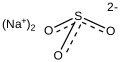
Sodium Sulfite
Physical Properties
- Molecular Weight: 126.04 g/mol
- Solubility (20°C): 270 g/L
- Solubility (50°C): 440 g/L
Also known as: Sulfite of Soda
Sodium sulfite (Na₂SO₃; CAS 7757-83-7) is the most widely-used preservative in photographic chemistry — a component of essentially every B&W developer, nearly every acid fixer, and many toner and stop-bath formulas. Its role is mechanical rather than photochemically active: sulfite ion scavenges dissolved oxygen that would otherwise oxidize reducing agents like metol, hydroquinone, or phenidone, keeping the developer usable for weeks rather than hours.[1] It also acts as a mild silver solvent, contributing to fine grain by partially dissolving the edges of the developing silver crystals during development.
Photographic uses
- Developer preservative: 50–100 g/L in most film and paper developer stocks. The exact concentration determines both shelf life and grain character — more sulfite means longer shelf life and finer grain, at the cost of reduced developer sharpness.
- Silver-solvent fine-grain developer: High-sulfite developers like D-23 (100 g/L) produce finer grain than low-sulfite formulas; this is the core mechanism behind "compensating" developers.[2]
- Wash-aid clearing bath (with sodium thiosulfate): 2% sodium sulfite in a "Hypoclear" bath helps wash residual fixer out of fibre-based paper faster than water alone.
- Carbonate-sulfite paper developer: D-72 / Dektol and similar formulas use sulfite for preservation and to soften the working contrast.
Practical notes
Supplied as either anhydrous Na₂SO₃ (the modern standard, free-flowing white powder) or the heptahydrate Na₂SO₃·7H₂O (older form, now uncommon, ~50% water by weight — multiply anhydrous formula weight by 2 for equivalent sulfite content). Most published photographic formulas assume anhydrous; if a formula is dated pre-1950 and specifies "sodium sulfite" ambiguously, check whether the given quantity makes physicochemical sense (if a 100 g/L specification produces oddly low sulfite activity in practice, it probably meant anhydrous, not hydrated).
The anhydrous salt is mildly hygroscopic — keeps for years in a tightly sealed container, but partially hydrated crystals weigh incorrectly. If your stock has developed a visible crust, dry at 120 °C for an hour before precision weighing.
Related compounds
Sodium sulfite anhydrous is the explicitly-anhydrous form (same chemical as this page). Sodium bisulfite is the acidic form (NaHSO₃); sodium metabisulfite is the anhydride (Na₂S₂O₅) that hydrolyzes to bisulfite in solution. Potassium sulfite (K₂SO₃) substitutes in many formulas but is less widely stocked.
References
- BOOK Modern Photographic Processing, Volume 2 1st ed. John Wiley & Sons, 1979. ISBN 0-471-04635-X. ↩
- BOOK The Darkroom Cookbook 4th ed. Focal Press, 2016. ISBN 9781138959170. ↩
- WEB Sigma-Aldrich Safety Data Sheets Sigma-Aldrich. https://www.sigmaaldrich.com/US/en/search/safety-data-sheets ↩