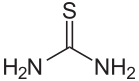
Thiourea
Physical Properties
- Molecular Weight: 76.12 g/mol
- Solubility (20°C): 142 g/L
Also known as: Thiocarbamide, Sulfourea
Thiourea (SC(NH₂)₂; CAS 62-56-6) is the odorless sepia toner — the modern replacement for sodium sulfide in two-bath sepia toning. Developed for darkroom work specifically to solve the "rotten egg smell" problem of sulfide sepia, thiourea produces the same silver-to-silver-sulfide image conversion through a different reaction pathway, without the hydrogen sulfide release that makes sulfide work so unpleasant.[1]
Photographic uses
- Thiourea variable sepia toner: The canonical modern sepia formula. A single-bath toner combining thiourea + sodium hydroxide (or other strong alkali) + bleached print produces sepia tones tunable from yellow-brown (low alkali) to purple-brown (high alkali).[2] The alkali concentration is the key variable: more NaOH = cooler, more purple tones; less NaOH = warmer, more yellow tones.
- Single-bath variable sepia: Combine the ferricyanide bleach with the thiourea-alkali redeveloper in one solution for simultaneous bleach-redevelop (with less tonal control than two-bath but simpler workflow).
- Odorless sepia work in shared darkrooms: Thiourea is the only practical sepia option for darkrooms in residential or shared workspace environments where the sulfide smell would be a problem.
Practical notes
Supplied as white odorless crystalline powder. Highly soluble in water. Solutions are stable indefinitely in closed containers.
Mixing order matters: dissolve the thiourea first in water, then slowly add the alkali (sodium or potassium hydroxide). Mixing in the reverse order can cause local pH spikes and partial precipitation.
Working solutions keep for weeks in covered trays (far longer than sulfide sepia, where the H₂S release degrades the working strength). Compared head-to-head, thiourea sepia is consistently preferred by contemporary darkroom workers who have tried both methods.
Regulatory status
Thiourea is classified as a Category 2 suspected carcinogen (H351) and possible reproductive toxin (H361) under the EU CLP system.[3] This is a recent classification reflecting animal studies; human relevance at darkroom exposure is debated. Nonetheless, glove discipline is warranted.
Related compounds
Sodium sulfide is the malodorous classical alternative. Diethylthiourea and allylthiourea are related thiourea derivatives sometimes used in specialty sepia formulas.
References
- BOOK The Film Developing Cookbook 2nd ed. Routledge, 2019. ISBN 9781138959187. ↩
- BOOK The Darkroom Cookbook 4th ed. Focal Press, 2016. ISBN 9781138959170. ↩
- STANDARD REACH Regulation (EC) No 1907/2006, Annex XVII – Restrictions on manufacture, placing on the market and use European Union. https://echa.europa.eu/substances-restricted-under-reach ↩
- WEB Sigma-Aldrich Safety Data Sheets Sigma-Aldrich. https://www.sigmaaldrich.com/US/en/search/safety-data-sheets ↩