Citric Acid
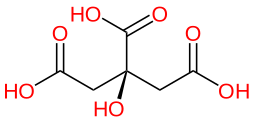
Physical Properties
- Molecular Weight: 192.12 g/mol
- Solubility (20°C): 1470 g/L
Also known as: Sour Salt, 2-Hydroxypropane-1,2,3-tricarboxylic Acid
Citric acid (C₆H₈O₇, CAS 77-92-9) is a weak organic tricarboxylic acid found naturally in citrus fruits and produced industrially by fermentation. In the darkroom it functions as an acidifier, a weak restrainer, and a chelating agent for metal ions.[1] Its main appeal over the traditional acetic acid stop bath is that it has no sharp vinegar smell and is food-grade — a meaningful improvement in any home or poorly-ventilated darkroom.
Photographic uses
- Citric acid stop bath: A 1–2% citric acid solution stops development almost as effectively as dilute acetic acid while being essentially odorless.[2] The stop bath remains usable until its pH begins to climb above roughly 4.5, at which point its capacity is exhausted.
- Fixer accelerator / preservative: A small amount of citric acid in an acid fixer buffers pH and extends tray life by slowing the formation of sulfur-yielding decomposition products in sodium thiosulfate or ammonium thiosulfate fixers.
- Clearing bath for alternative processes: A dilute citric acid rinse (roughly 1%) is used to clear iron staining after cyanotype printing and related iron-based processes[3] — it chelates residual iron more aggressively than a simple water wash.
- Toner buffer: Citric acid is used in some gold and selenium toners to stabilize pH and slow the toning rate, giving more predictable colour shifts. Compare with tartaric acid, which serves a similar role in traditional iron-based toner formulas.
- Hard-water correction: Citric acid chelates calcium, magnesium, and iron in hard tap water, preventing the mineral scum and drying marks that otherwise appear on film and paper. A pinch in the final wash or wetting-agent bath is a standard trick in hard-water areas.
Practical notes
Citric acid is supplied as anhydrous crystals or as the monohydrate (roughly 95% of the anhydrous weight after accounting for water of crystallization). Either works in darkroom solutions as long as the form is known and the weight adjusted accordingly. The monohydrate is what typically shows up in home-brewing and canning-supply stocks, which is the most economical retail source for photographic use. Stock solutions keep for months in closed glass; dry crystals are stable essentially indefinitely when kept dry.
pH behavior: A 1% solution has a pH of roughly 2.3; a 10% solution roughly 1.8. Unlike acetic acid, citric acid's three ionizable protons give it some buffering capacity, so pH drifts less during use.
Disposal
Dilute citric acid solutions (≤5%) are safe to pour down a domestic drain with plenty of running water in most jurisdictions — the volumes involved in home darkroom work are negligible relative to municipal wastewater treatment. Used stop baths, however, will contain developer residues with whatever environmental profile the developer carries; dispose of spent stop baths according to the hazardous-waste rules for the developer they contain, not the citric acid.
Food-grade sourcing
The cheapest and purest source of citric acid for darkroom use is the food-grade "sour salt" sold for canning, brewing, and cooking. These products are typically 99.5%+ pure anhydrous or monohydrate citric acid, well within analytical-grade specifications for any photographic purpose. ACS-grade citric acid is available from chemistry suppliers but offers no practical advantage for darkroom solutions.
Related compounds
Tartaric acid is the closest photographic analogue — a weak organic acid with similar stop-bath potential but preferred in iron/gold toner formulas where its different chelating behavior with metal ions matters. Acetic acid is the traditional alternative for stop baths (much sharper vinegar smell but identical chemical function at equivalent pH).
References
- BOOK Modern Photographic Processing, Volume 2 1st ed. John Wiley & Sons, 1979. ISBN 0-471-04635-X. ↩
- BOOK The Film Developing Cookbook 2nd ed. Routledge, 2019. ISBN 9781138959187. ↩
- WEB alternativephotography.com alternativephotography.com. https://www.alternativephotography.com/ ↩
- WEB Sigma-Aldrich Safety Data Sheets Sigma-Aldrich. https://www.sigmaaldrich.com/US/en/search/safety-data-sheets ↩