Tartaric Acid
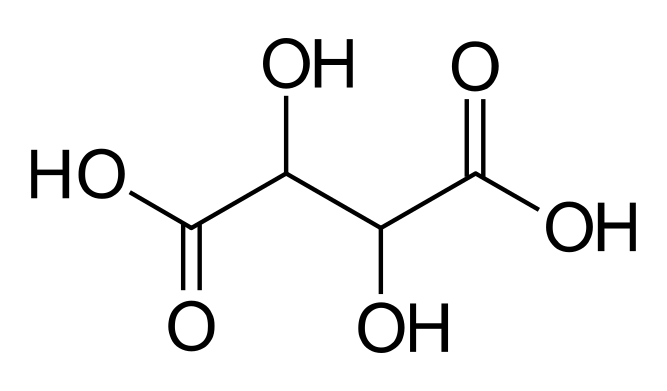
Physical Properties
- Molecular Weight: 150.09 g/mol
- Solubility (20°C): 1330 g/L
Also known as: L-Tartaric Acid, Dihydroxybutanedioic Acid
Tartaric acid (C₄H₆O₆, CAS 87-69-2) is a weak organic diprotic acid that occurs naturally in grapes, bananas, and other fruit; commercial supply is a byproduct of winemaking, where it crystallizes out of stored wine as potassium bitartrate (cream of tartar). In darkroom chemistry it plays a narrower role than its close cousin citric acid, but is specifically called for in several historical and fine-art process formulas where its particular chelating and mild-reducing behavior cannot be substituted.[1]
Photographic uses
- Iron-based toners: Tartaric acid is the acidifier in classical iron blue (Prussian blue) toners and some iron intensifiers, where it coexists in solution with potassium ferricyanide or ferric ammonium citrate without precipitating them. Citric acid also works here, but tartaric gives slightly warmer tones in some formulas.
- Gold toners (sel d'or type): Classic sel d'or and several contemporary gold toners include tartaric acid as a mild reducing agent and pH buffer.[2] It helps drive the tone change from warm silver black to neutral blue-black without over-bleaching the print.
- Platinum/palladium sensitizer component: Some historical platinum/palladium printing formulas use potassium tartrate or a small amount of tartaric acid to modify contrast — though the modern workflow typically uses ammonium dichromate or a chlorate restrainer instead.
- Print developer additive: A trace of tartaric acid in warm-tone silver paper developers gives slightly warmer image tones through subtle changes in grain structure during development.
- Van Dyke brown and Kallitype: Tartaric acid controls the sensitizer's stability and development speed in several iron–silver processes.[3]
Practical notes
Tartaric acid is supplied as L-tartaric acid (naturally occurring), D-tartaric acid (synthetic enantiomer), or racemic DL-tartaric acid. Photographic formulas do not distinguish between enantiomers — any food-grade or reagent L-tartaric acid is appropriate. Like citric acid, it is routinely sold as a food-grade product at winemaking-supply houses at a fraction of chemistry-supplier prices. A saturated solution at room temperature is roughly 20% w/w. Dry crystals keep indefinitely; solutions keep for many months in closed glass.
Disposal
Dilute tartaric acid solutions (≤5%) without additional toxic components are safe to pour to drain with running water. However, tartaric acid is most often found in toning and intensifier solutions containing heavy metals (iron, gold, sometimes silver) — dispose of these according to the heavy-metal rules for the toner, not the tartaric acid carrier. Metal-containing tartaric solutions should go to hazardous-waste collection.
Food-grade sourcing
Winemaking and brewing suppliers carry food-grade L-tartaric acid at a small fraction of chemistry-supplier prices. Purity is typically 99.5%+ and fully suitable for any darkroom use. Reagent-grade tartaric offers no practical advantage.
Related compounds
Citric acid is the closest photographic analogue — both are mild organic acids used in similar roles, but tartaric's ability to form soluble complexes with iron and gold ions at higher pH than citric makes it preferred in metal-based toner formulas. Citric is the better general-purpose choice for stop baths and fixer buffering; tartaric is the better choice when a recipe specifically calls for it.
References
- BOOK The Keepers of Light: A History and Working Guide to Early Photographic Processes 1st ed. Morgan & Morgan, 1979. ISBN 0-87100-158-6. ↩
- BOOK The Darkroom Cookbook 4th ed. Focal Press, 2016. ISBN 9781138959170. ↩
- WEB alternativephotography.com alternativephotography.com. https://www.alternativephotography.com/ ↩
- WEB Sigma-Aldrich Safety Data Sheets Sigma-Aldrich. https://www.sigmaaldrich.com/US/en/search/safety-data-sheets ↩