Ferric Ammonium Citrate
Physical Properties
- Molecular Weight: 265 g/mol
- Solubility (20°C): 1200 g/L
Also known as: Iron(III) Ammonium Citrate, Green/Brown FAC
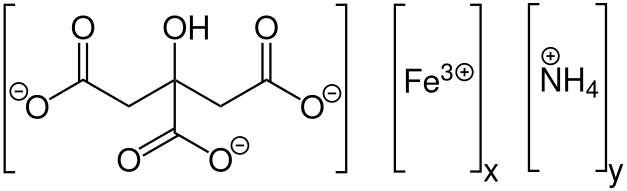
Ferric ammonium citrate (often abbreviated FAC; CAS 1185-57-5) is an iron-citrate complex best known as the UV-sensitive component of the cyanotype process and other iron-based alternative photographic processes.[1] It is sold in two forms — green (more soluble, more photosensitive, the form called for in almost every classical formula) and brown (partially polymerized from aging; slower; still usable but not preferred). The exact stoichiometry is variable; commercial FAC is a family of closely-related complexes with approximate composition C₆H₈O₇·xFe·xNH₃ rather than a single well-defined salt, which is why both the formula and the appearance differ slightly between suppliers.
Photographic mechanism
FAC's photochemistry is the textbook example of iron photoreduction.[2] Ultraviolet light (or strong blue-violet visible light) reduces the ferric iron (Fe³⁺) in the complex to ferrous iron (Fe²⁺), producing a latent image of Fe²⁺ in proportion to the light received. In classical cyanotype the Fe²⁺ then reacts with potassium ferricyanide to form ferric ferrocyanide — Prussian blue — the deeply coloured pigment that gives the process its name. In Van Dyke brown and kallitype the reduced iron instead reduces silver nitrate to metallic silver, producing a warm-tone silver image. In gold/platinum/palladium printing the ferrous iron reduces a noble-metal chloride to the metal itself. The common thread is that FAC serves as a light-controlled source of Fe²⁺, and the choice of second component determines what final image substance forms.
Common photographic uses
- Classic cyanotype: The 1842 Herschel formula uses roughly 25% FAC (green form) mixed with 10% potassium ferricyanide, contact-printed under UV, and washed in plain water.[3] The simplest serious alt process and the one most darkroom workers learn first.
- New cyanotype (Ware): Mike Ware's reformulation substitutes ferric ammonium oxalate for FAC in the sensitizer, giving higher contrast, extended tonal range, and better shadow separation.[1] Still uses potassium ferricyanide as the developing partner.
- Van Dyke brown: FAC plus silver nitrate plus tartaric acid produces rich sepia-brown silver images on plain paper, developed in a simple water wash.[4]
- Kallitype: A silver-iron process related to Van Dyke; uses FAC (or occasionally ferric oxalate) as the iron source, with development in sodium citrate or oxalate.
- Platinum/palladium printing: FAC is the ferric salt in most Pt/Pd sensitizer formulations; traditional recipes also use ferric oxalate. The UV-reduced Fe²⁺ reduces the platinum or palladium chloride to the metal.
- Blue toning of silver prints: A dilute solution of FAC plus potassium ferricyanide applied to an existing silver gelatin print produces Prussian-blue tones, similar to but distinct from cyanotype (the image substrate is silver rather than iron).[5]
Practical notes
Green FAC crystallizes in translucent green scales or platelets; brown FAC is amorphous granular or flaky material. Both are freely soluble in water, but the green form dissolves more readily and produces more active sensitizers. Solubility is roughly 50 g/100 mL at room temperature — far more than any formula calls for.
Solutions are sensitive to any incident UV or strong visible light and photo-fog steadily in open tray conditions. Prepare stock solutions under safelight or in dim indirect light; store in amber glass bottles in a dark cabinet. A well-prepared 25% stock keeps for several months; discard when it darkens significantly (an olive-to-brown shift indicates partial photoreduction already underway).
Ferric ammonium citrate is deliquescent — dry crystals pick up atmospheric moisture over time. Store with desiccant in a tightly sealed jar. Crystals that have absorbed water can still be dissolved and used; just weigh carefully.
Disposal
Dilute FAC solutions and spent cyanotype wash water pose no meaningful environmental hazard — iron and citrate are benign end products of municipal wastewater treatment. Used toning or printing solutions containing dissolved silver should be collected as heavy-metal waste regardless of the iron content.
Related compounds
Ferric ammonium oxalate is FAC's closest cousin and the sensitizer used in Mike Ware's New Cyanotype formula — more sharply photosensitive and gives cleaner highlights, but is more expensive and stocked by fewer suppliers. Ferric chloride is a different ferric salt used in some toners but not typically as a photosensitizer (its chemistry favours precipitation reactions over photoreduction). Ferrous sulfate is the already-reduced Fe(II) counterpart, used as a developer in collodion and some iron-based development baths rather than as a light-sensitive salt.
References
- BOOK Cyanotype: The History, Science and Art of Photographic Printing in Prussian Blue 1st ed. NMSI Trading Ltd (Science Museum), 1999. ISBN 1-900747-07-3. ↩
- BOOK Modern Photographic Processing, Volume 2 1st ed. John Wiley & Sons, 1979. ISBN 0-471-04635-X. ↩
- BOOK The Darkroom Cookbook 4th ed. Focal Press, 2016. ISBN 9781138959170. ↩
- WEB alternativephotography.com alternativephotography.com. https://www.alternativephotography.com/ ↩
- BOOK Historic Photographic Processes: A Guide to Creating Handmade Photographic Images 1st ed. Allworth Press, 1998. ISBN 1-58115-024-4. ↩
- WEB Sigma-Aldrich Safety Data Sheets Sigma-Aldrich. https://www.sigmaaldrich.com/US/en/search/safety-data-sheets ↩