Why grain matters
Film grain is the visible texture in a B&W negative caused by clusters of developed silver halide crystals. It is inherent to the silver photographic process — every B&W film and developer combination produces some grain — but the visible grain in a final print depends as much on developer choice, agitation, and enlargement size as on the film itself.
For most photographers in 2026, grain is primarily a 35mm + scanning-era concern. At 4×5 sheet film with a contact print, grain is essentially invisible. At 35mm enlarged to 16×20", grain dominates. At any format scanned at 4000+ DPI, grain becomes visible at pixel-peeping zoom levels even when the final print would hide it.

Fine-grain development is the toolkit for managing this visible grain — sometimes worth the trade-offs, sometimes not.
How fine-grain developers work
Fine-grain developers reduce visible grain through two distinct chemical mechanisms, often combined:[1]
1. Solvent action
Sodium sulfite at high concentrations (and some other agents like sodium chloride and sodium thiocyanate) partially dissolves the edges of developed silver grains and redeposits the silver into the grain clump. This "rounds off" the sharp edges of grain clusters, making them appear smaller and smoother. The mechanism is straightforward physical chemistry: silver halide is slightly soluble in concentrated sulfite, and dissolution proceeds preferentially at sharp corners and edges where surface tension is highest.
D-76 (Kodak) and ID-11 (Ilford — the same formula under different branding) rely heavily on this mechanism with 100 g/L sodium sulfite. Microdol-X (Kodak) added sodium chloride to amplify the effect. Perceptol (Ilford) does the same job through a slightly different sulfite formulation.
The trade-off: heavy solvent action reduces edge sharpness (acutance). Grain that's been "rounded" produces softer grain-to-grain transitions, which the eye reads as both finer grain and lower edge contrast. This is the fundamental tension in fine-grain development — you can have the rounded grain or the crisp edges, not both.
2. Low-energy development
Gentle developers with mild accelerators (borax rather than sodium carbonate) produce smaller initial grain clumps. The developing agents work slowly and evenly, building density without creating the large, clumped grain structures that vigorous developers produce.
D-76's borax accelerator (vs Dektol's sodium carbonate) is a low-energy choice; the slow, controlled development gives the solvent action time to work and produces smaller grain to begin with.
The trade-off: low-energy development takes longer (8-10+ minutes vs 4-5 for vigorous developers), and the slow build of density means push-processing performance suffers — fine-grain developers do not push well.
The fine-grain developer family
The major fine-grain developers, ranked roughly by grain-reduction strength:[2]
- D-76 / ID-11 stock: The benchmark fine-grain developer. At full strength (no dilution), the high sulfite concentration provides excellent solvent action. Fine grain with good speed (no measurable speed loss vs box rating) and full tonal range. The "default" fine-grain choice for most B&W work. Develop ~9-10 minutes for most ISO 400 films at 20°C.
- D-76 / ID-11 1:1: Diluted reduces the solvent effect, increasing apparent grain but improving acutance. Most photographers actually prefer 1:1 dilution because the sharpness gain outweighs the modest grain increase. Develop ~11-13 minutes (longer than stock).
- Microdol-X (discontinued 2018, freezer-stock available): Even finer grain than D-76 stock through additional solvent action from sodium chloride. Costs approximately ⅓ to ⅔ stop of film speed (an EI 400 film performs at EI 250-320). Discontinued by Kodak in 2018; freezer-stock photographers use this through ~2030 then transition to Perceptol or Adox Rodinal Special.
- Perceptol stock: Ilford's answer to Microdol-X. Ultra-fine grain with similar ⅓-⅔ stop speed loss. Currently in production; the live alternative to discontinued Microdol-X.
- XTOL stock: Modern fine-grain developer (introduced 1996; reformulated 2014 to address premature failure). Achieves fine grain comparable to D-76 without the speed loss, plus better keeping properties as a working solution. The single best modern choice for photographers who want fine grain + speed + reliability. Develop ~9-10 minutes.
- D-23: Two-ingredient simplicity (Metol + sodium sulfite only). Excellent grain characteristics from the high sulfite content. Often used as a "compensating" developer for high-contrast subjects — the simple formula gives predictable behavior and easy modification (split-developer D-23, replenished D-23, etc.). Develop ~10-12 minutes.
- Pyrocat-HD (very dilute): A staining developer; not strictly a fine-grain developer but produces very fine apparent grain through the stain mass that fills in between silver grains. Choose Pyrocat-HD when both fine grain and acutance matter (the staining mechanism preserves edge contrast that solvent action would soften).
When to choose fine-grain vs high-acutance
The fundamental trade-off in B&W development is fine grain vs edge sharpness — the two are inversely related, and you choose which matters more for the print:
| Goal | Choice | Reason |
|---|---|---|
| Maximum grain reduction (35mm enlarged 11×14+) | Microdol-X / Perceptol stock | Solvent action is dominant |
| Best balance for 35mm | D-76 1:1 or XTOL stock | Compromise both ways |
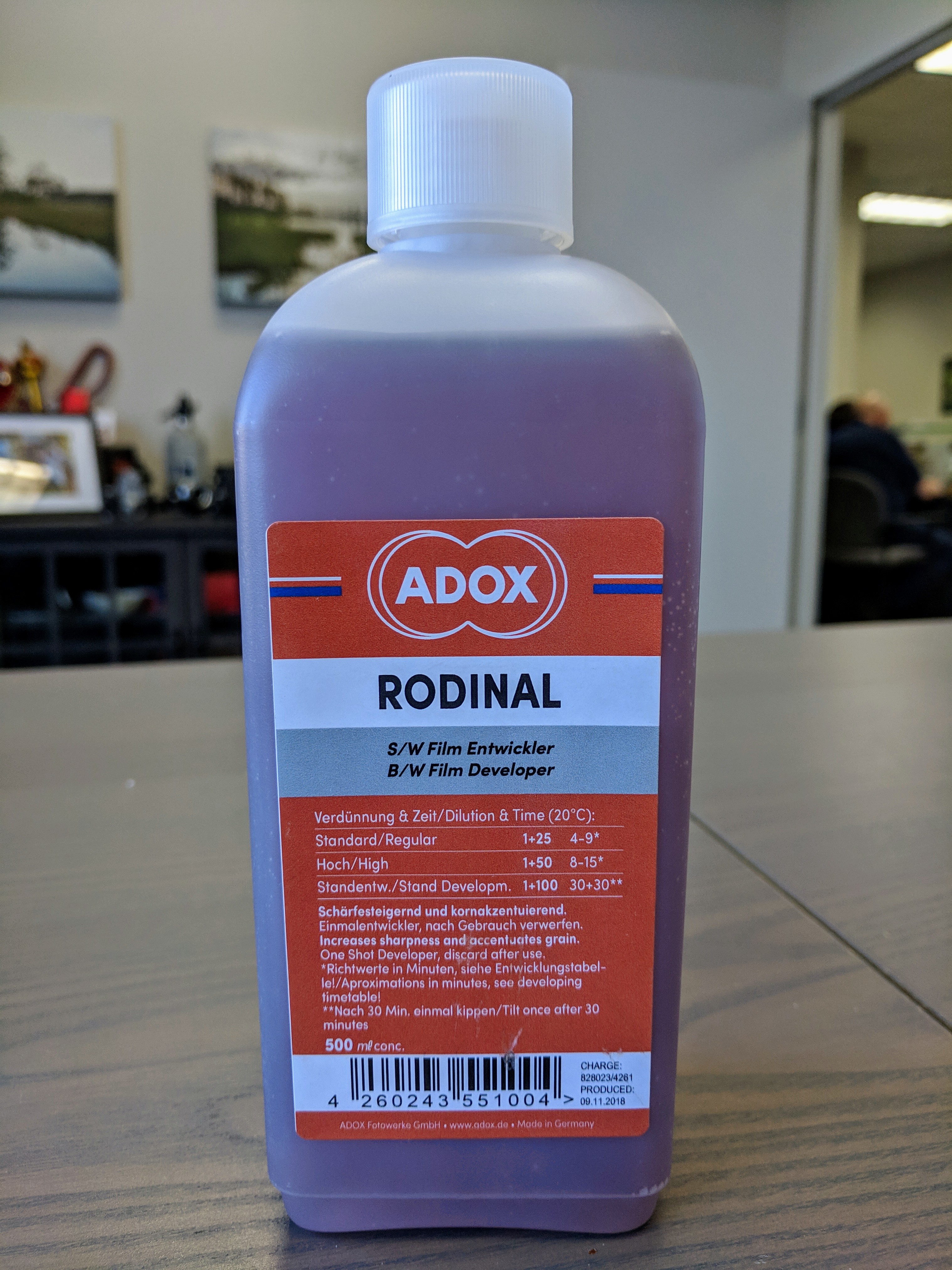
| Maximum sharpness (any format) | Rodinal 1:50 or Pyrocat-HD |
| Acutance over grain | | Modern reliable fine grain | XTOL stock | No speed loss; long working-solution life | | Push processing | Microphen / DD-X | Fine-grain developers lose speed | | 4×5+ sheet film | D-76 stock or HC-110 Dil B | Grain is invisible regardless |
Choose fine-grain when the viewing distance × magnification product makes grain visible. For 35mm at 8×10 viewed at 12 inches, grain is a moderate concern. For 35mm at 16×20 viewed at 18 inches, grain dominates. For 4×5 contact prints viewed at 8 inches, grain is invisible — fine-grain developers waste their advantage.
Scanning implications
Fine-grain development behaves differently when the negative is scanned at high resolution vs wet-printed in an enlarger:
- Wet enlargement preserves the apparent fine-grain advantage — the analog optical chain (negative → enlarger lens → paper) softens grain edges naturally
- High-resolution scanning (4000+ DPI Imacon, dedicated film scanner, drum scan) captures grain as data points, surfacing structure that wet-printing hides. Fine-grain development still helps, but the scanned negative reveals more grain than the equivalent wet print.
- Implication: photographers who scan exclusively may want to favor slightly coarser-grained developers (D-76 1:1 vs Microdol-X stock) to get a more film-like grain texture in the scan rather than a flat, plasticky look. Pure fine-grain developers can produce scans that look "digitally smoothed."
- Inverse: photographers who only wet-print can push fine-grain development further (Microdol-X stock, Perceptol stock) without the scan-flatness penalty.
Practical workflow for minimum visible grain
Beyond developer choice, these practices minimize visible grain:[2]
- Use stock-strength developers: Dilution reduces the solvent effect, increasing apparent grain. Stock D-76 produces noticeably finer grain than D-76 1:1 — choose the dilution based on whether grain or sharpness matters more.
- Develop at 20 °C (68 °F) precisely: Higher temperatures increase grain (chemical reaction rates accelerate non-linearly, producing larger grain clumps). Never develop fine-grain work above 24 °C.
- Use standard agitation: Consistent, gentle agitation (5-second inversions every 30 seconds) produces the most even grain pattern. Aggressive agitation introduces uneven density and visually amplifies grain.
- Expose generously: Underexposure followed by push processing is the enemy of fine grain. Rate film at box speed or slightly below (EI 320 for ISO 400 films).
- Choose the right film: Medium-speed films (ISO 100-125) have inherently finer grain than fast films. T-grain emulsions (T-Max 100/400, Delta 100/400) have finer grain than cubic-grain films (Tri-X, HP5+) at the same ISO.
- Avoid water-bath techniques: Water-bath development reduces highlight density but tends to amplify grain. Choose a single-bath fine-grain developer instead.
The trade-off
Fine grain always involves trade-offs. Maximum grain reduction typically means:
- Some loss of film speed (0 to 1 stop depending on developer; XTOL is the only modern fine-grain developer with no speed loss)
- Slightly reduced acutance (edge sharpness) due to solvent action
- Lower apparent sharpness compared to high-acutance developers like Rodinal or Pyrocat-HD
- Weaker push-processing performance — fine-grain developers do not push well
For most work, D-76 1:1 or XTOL stock offers the best balance of grain, speed, and sharpness. Reserve ultra-fine-grain developers (Microdol-X, Perceptol stock) for situations where grain is the primary concern and the speed/sharpness compromises are acceptable.
Related techniques and recipes
- High-Acutance Development — the opposite-trade-off counterpart; choose this when sharpness matters more than grain
- Compensating Development — adjacent technique where dilute developer is the goal; D-23 split-developer variants live here
- D-76 — the benchmark fine-grain developer recipe
- Perceptol — Ilford's ultra-fine-grain alternative; the live Microdol-X successor
- XTOL — modern fine-grain without the speed loss
- Microdol-X — historical reference; freezer-stock workflow only (discontinued 2018)
- D-23 — the simple two-ingredient fine-grain alternative
- Pyrocat-HD — staining alternative when both fine grain and acutance matter