Sulfuric Acid
Physical Properties
- Molecular Weight: 98.08 g/mol
- Solubility (20°C): 1000 g/L
Also known as: Oil of Vitriol, Battery Acid, H2SO4
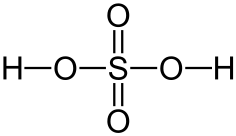
Sulfuric acid (H₂SO₄; CAS 7664-93-9) is the strong mineral acid of photographic chemistry — a viscous, dense, colourless liquid used in specialty bleaches, intensifier formulas, and as the acid component in some silver-recovery cells.[1] Most routine darkroom work uses the much safer weak organic acids (acetic acid, citric acid, tartaric acid), but a handful of formulas specifically require strong mineral acid chemistry that only sulfuric can provide.
Photographic uses
- Chrome intensifier / chromium intensification: A historical intensifier formula uses dilute sulfuric acid + potassium dichromate to convert silver image to chromium-silver complex for increased density. Rare today; dichromate handling concerns have largely retired this technique.
- Permanganate bleach acidifier: Potassium permanganate-based reversal bleaches require acidic pH for the bleach chemistry to work; dilute sulfuric acid (1–2%) is the usual acidifier.
- Silver recovery (electrolytic): Electrolytic silver recovery cells use sulfuric acid as the electrolyte for the electrochemistry that deposits silver on a cathode for commercial recovery.
- Ferrous sulfate stabilization: A few drops of dilute sulfuric acid per litre of ferrous sulfate developer stock extends shelf life by suppressing Fe(II)→Fe(III) oxidation.
Practical notes
Supplied as concentrated sulfuric acid (96–98% w/w), a viscous colourless oily liquid, or as various dilute solutions (10%, 25%, "battery acid" at ~37%). Concentrated sulfuric acid is dangerously reactive with water — dissolution is strongly exothermic, and adding water to concentrated acid can boil the water explosively, spraying hot acid out of the container.
The absolute rule: always add acid to water, slowly, with continuous stirring. The water must be in a large vessel capable of absorbing the dissolution heat without overheating. Never reverse this — the reverse is a classical laboratory injury scenario.
Dilute stock solutions (10–37%) are much safer to handle but still corrosive. Store in glass; concentrated sulfuric attacks most plastics over time.
Related compounds
Acetic acid is the weak organic acid of photographic stop baths. Nitric acid and hydrochloric acid are alternative strong mineral acids used in some alt-process formulas.
References
- BOOK Modern Photographic Processing, Volume 2 1st ed. John Wiley & Sons, 1979. ISBN 0-471-04635-X. ↩
- WEB Sigma-Aldrich Safety Data Sheets Sigma-Aldrich. https://www.sigmaaldrich.com/US/en/search/safety-data-sheets ↩